
The Riding Mountain Artists’ Residency gives Manitoban artists time to focus on their work in the beautiful natural setting of Riding Mountain National Park.
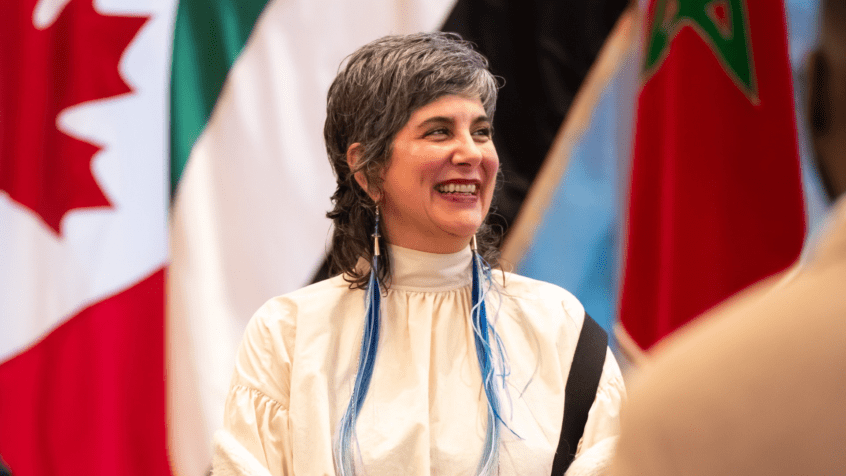
The first artist-in-residence for the 2026 season is Geneviève Pelletier. Ahead of her time in the historic Deep Bay Cabin, Geneviève answered a few of our questions about her work and how she’ll be spending her residency.
MAC: Tell us a little about yourself as an artist and your practice.
Geneviève: I am a Red River Métis artist, stage director, translator and cultural leader based in Winnipeg, on Treaty 1 territory. My practice involves artistic creation, dramatic narrative and intercultural collaboration. I have worked in Canada and abroad for over 20 years, exploring mixed narratives, complex identities and the meeting spaces residing between languages, cultures and territories.
My career includes managing the Théâtre Cercle Molière from 2012 to 2025, where I worked with many artists on many creative projects. These days, I have an independent practice that is focused on research, coaching, writing and theatrical translation.
Tell us about your project — what will you be working on in the Deep Bay Cabin?
I will be working on the French translation of Café Daughter, a major work of contemporary Indigenous theatre by Kenneth T. Williams.
This residency is an essential step in improving the dramatic quality of the translation by refining the work’s oral structure, rhythm, silences and nuances. It is a project that requires painstaking attention to detail, which requires time, listening and close attention to identify and immerse oneself in the languages that inhabit the script.
What is your relationship with the park?
I’m a big fan of the park. I’ve been there several times over the years (in summer and winter as well as fall and spring). Last fall, I had the great pleasure of spending time in the park, all by myself. I really enjoyed the spa. The town of Wasagaming is also one of my favourite places in the province. Walking in the park is fantastic. And nature even more so.
I can’t wait to reexperience its landscapes, its rhythms, its light and above all to observe how the environment will influence my interpretation of the script. For me, every territory bears a memory and a presence that can fuel the creative process.
How do you hope the park will influence or inspire your project or practice?
I hope the park setting will provide me with a space to slow down and focus that is conducive to rigorous work. Theatrical translation requires a special kind of attentiveness.
The contact with the land, the silence and the separation from everyday life will allow me to refine this attentiveness and, I believe, to open up new resonances in the script. I hope this full immersion will influence the rhythm and breath of the translation itself.
Anything else you’d like to share with readers and the Riding Mountain National Park community?
I’d like to ask visitors and the community to not consider translation as a simple transition from one language to another, but rather as a meeting place. A place where not only words flow, but also stories, silences and relationships.
The public presentation will be an opportunity to share this process in a spirit of dialogue, curiosity and respect. And, if possible, to create a time of gathering, perhaps even over a meal, in simplicity and friendliness.
The Riding Mountain Artists’ Residency is offered in partnership by the Manitoba Arts Council, Wasagaming Community Arts, and Riding Mountain National Park.
Interested in the staying in the Deep Bay cabin? Find out how to apply to the Riding Mountain Artists Residency through the Learn – Residencies grant stream. Apply by January 15, 2027 for a residency in the summer of 2027.
